The SynFi model
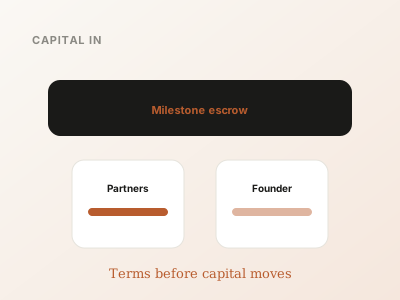
The owner raises capital.
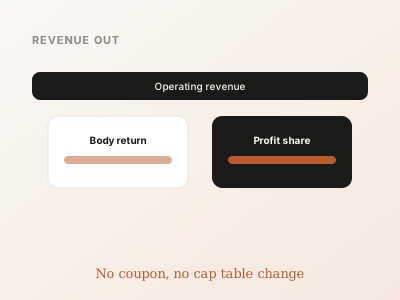
Partners receive a share of revenue.
SynFi connects capital and an operating project through a revenue-share agreement. No interest. No sale of company equity. Terms, roles, and payout order are set before funds are raised — everyone works from one contract, not scattered side deals.
How the model works
Structure. Funding. Revenue share.
The owner sets the capital need, delivery stages, and the share of future revenue for partners. Partners join the deal, contribute funds, and receive payouts as the project earns.
Step i
Structure the deal
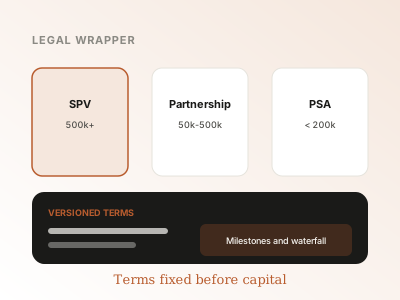
You choose a legal form: SPV, simple partnership, or profit participation agreement. Before capital is raised, stages, revenue distribution order, and reporting duties are fixed. The platform suggests a form based on deal size, partner count, asset type, and jurisdiction.
Step ii
Fund by stage
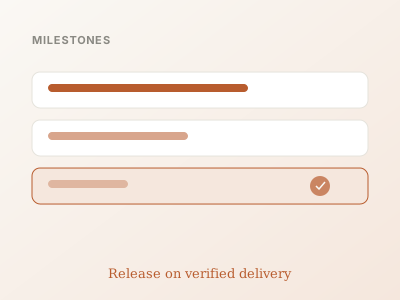
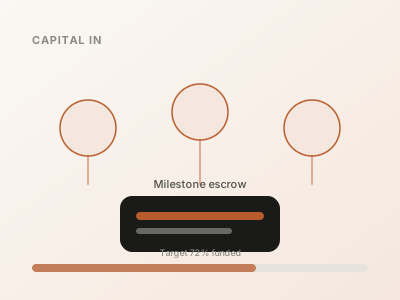
Partner funds are collected in escrow through EvoPay. The deal starts only after the target amount is reached — otherwise money is returned. A new tranche opens when partners confirm that a stage is complete.
Step iii
Share of revenue
Project revenue is split by contract: return of contributions first, then a share of profit. No interest and no sale of company equity. When partners have received the agreed return, the deal closes. All payouts are recorded on the platform.
How payouts are split
Every payout has two parts
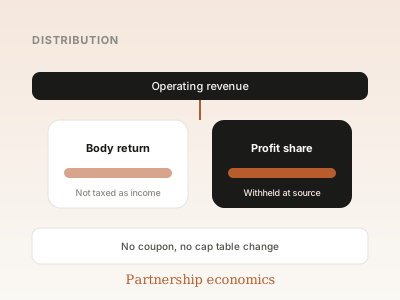
Every payout has two parts: return of invested capital and a share of profit. SynFi withholds tax on the profit share as tax agent.
Return of capital
Contribution body first
- Returns partner contributions from project revenue
- Not treated as taxable income in this structure
- Tracked per partner on the platform
- Visible in partner reports and accounting
Profit share
Share in the result
- Paid after priority return of capital
- Tax withheld at source by SynFi
- No interest and no dilution of the owner’s equity
- Formula fixed in the contract before funding
Deal close
Target reached
- The deal closes when the agreed return target is met
- Every payout is recorded on the platform
- Contract terms stay linked to actual payouts
- Reporting is built on the platform, not from scattered participant files
Legal structure of the deal
One economic model.
Three forms of contract.
Each deal is wrapped in a form that fits its size, partner count, and asset type. The platform suggests an option — you choose and lock the terms before capital is raised.
SPV
Separate legal entity
A dedicated company is created for the project. Partners join as participants. Deal risks and assets stay separate from other businesses.
Simple partnership
Joint activity
An agreement among partners without a new legal entity. Simpler and faster than an SPV for a small group.
Participation agreement
Profit participation
A direct contract with the project’s existing legal entity. Partners share in profit without taking ownership.
What sets it apart
Partnership financing and familiar alternatives
Bank loans, venture capital, and public fundraising solve different problems. SynFi is for those who need capital without interest and without selling equity — and for partners who want a share of real project revenue.
i
vs bank loan
No interest from day one and no bank restrictions on cash flow. Return is tied to project revenue, not a fixed schedule regardless of results.
ii
vs venture capital
No new shares, board seats, or complex preferences. Partners share revenue by contract — the owner’s equity is not diluted.
iii
vs public fundraising
Participation by invitation within a workspace — not a public retail campaign. Terms are designed for qualified participants.
iv
Transparency by default
Contract, escrow, accounting, and partner reports live in one system — deal terms and actual payouts stay linked.
Get started
Ready to structure a partnership deal?
Submit a project, become a partner, or review the full process. SynFi is co-financing with clear economics — not a deposit, security, or investment recommendation.